
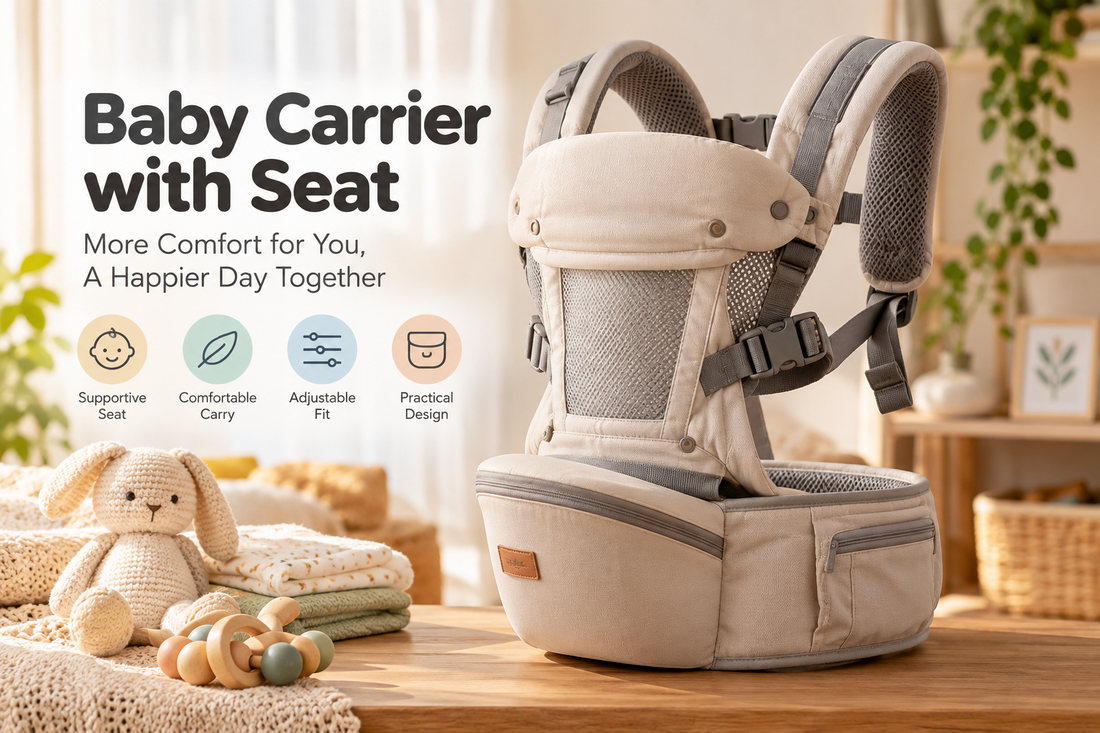
A baby chest carrier can help parents keep their little one close while leaving their hands more available for everyday movement. Also commonly described as a front baby carrier, this style positions the baby against the caregiver’s chest using fabric, straps, buckles, or a combination of these features.
Choosing the right carrier means looking beyond softness or appearance. Baby age, weight, head support, carrying direction, caregiver adjustment, and fabric all influence comfort. This guide explains how chest carriers work, how they compare with wraps and other carrier styles, and what parents should consider before choosing one.
What Is a Baby Chest Carrier

A baby chest carrier is designed to hold a baby against the front of the caregiver’s body. Depending on the product, the baby may face inward toward the caregiver or use another approved front-facing position at a later developmental stage.
Chest carriers can range from soft fabric wraps to more structured buckle carriers.
Common features include:
-
Adjustable shoulder straps
-
Supportive carrier panel
-
Waist support on structured models
-
Head and neck support
-
Secure buckles or fabric wrapping
-
Different front carrying positions
-
Padded or breathable materials
Parents can explore different designs in the Baby Carriers collection, where Mommy’s Mart brings soft and structured carrying styles together.
Understanding the basic carrier type makes choosing the right fit much easier.
Front Baby Carrier vs Other Carrier Styles
A front baby carrier keeps the child close to the caregiver’s chest, while other products may focus on hip, back, or wrap-based carrying.
|
Carrier Style |
Main Position |
Typical Benefit |
|
Chest carrier |
Front of caregiver |
Close contact and easy monitoring |
|
Baby wrap |
Front using fabric |
Soft, flexible fit |
|
Hip seat |
Supported around waist |
Useful for repeated pick-up |
|
Back carrier |
Behind caregiver |
Often considered at later stages |
|
Structured carrier |
Varies by model |
Defined straps and support |
A baby chest carrier can be particularly practical during earlier stages because the caregiver can see and monitor the baby more easily.
The right carrier style depends on your baby’s stage and your normal routine.
Why Parents Choose a Chest Baby Carrier
A chest baby carrier can be useful during daily activities when parents want to keep their baby nearby without holding them constantly in their arms.
Parents may use one for:
-
Short walks
-
Shopping trips
-
Family visits
-
Moving around the house
-
Airports and travel
-
Crowded places
-
Quick everyday errands
A properly fitted carrier can also reduce the need to constantly reposition the baby in your arms.
Parents who want to compare several styles can browse Baby Carriers at Mommy’s Mart before choosing.
A front carrier is most useful when it fits naturally into your everyday routine.
Baby Chest Carrier for Newborns
A baby chest carrier for a newborn requires additional attention because very young babies have limited head and neck control.
Never assume that every soft carrier is suitable from birth.
Before using a newborn chest carrier, check:
-
Minimum weight
-
Starting age
-
Head support
-
Back support
-
Approved inward-facing position
-
Carrier adjustment
-
Manufacturer instructions
For parents looking for a softer newborn option, the Bnon Baby Wrap Carrier is one product parents can compare with structured front carriers.
A newborn should only use a carrier specifically approved for the baby’s current stage.
Infant Front Carrier Support
An infant front carrier needs to support the baby’s body according to both age and development.
During early infancy, parents should pay particular attention to the baby’s head, neck, back, and overall position inside the carrier.
A good baby chest carrier should allow parents to check that:
-
Baby remains close
-
The face stays visible
-
The nose and mouth remain clear
-
The body does not sink too deeply
-
Head support is appropriate
-
Straps remain secure
The fit should be checked again after movement because soft fabrics and adjustable straps can shift slightly during use.
Good front carrying starts with a secure, easy-to-monitor position.
Inward Facing Baby Chest Carrier

Inward-facing carrying positions the baby toward the caregiver’s chest.
This is one of the most common positions associated with a baby chest carrier, particularly during earlier stages when close support and monitoring matter.
Potential advantages include:
-
Close contact
-
Easier monitoring
-
Baby faces the caregiver
-
Simple front access
-
Comfortable positioning on compatible carriers
Parents should still follow the individual product instructions because head support, seat setup, and minimum weight vary between models.
Inward carrying is simple, but correct adjustment remains essential.
When Can Baby Face Forward
Parents often want to know when they can turn the baby outward in a baby chest carrier.
There is no universal age.
Outward-facing use should begin only when:
-
The specific carrier allows it.
-
The baby meets its developmental requirements.
-
Head and upper-body control are sufficient.
-
Baby remains inside the approved weight range.
-
The carrier is adjusted for that position.
Age alone should not determine the change.
The manufacturer’s guidance and your baby’s development should decide when a new front position becomes appropriate.
Ergonomic Chest Carrier Features
An ergonomic chest carrier should provide appropriate support for both the child and caregiver.
The word ergonomic does not simply mean thick padding.
Look for:
-
Appropriate baby seat design
-
Adjustable shoulder straps
-
Stable carrier panel
-
Waist support where included
-
Correct baby positioning
-
Balanced weight distribution
A structured baby chest carrier should stay close to the caregiver instead of hanging away from the body.
Parents can compare structured options such as the Chicco Soft and Dream Baby Carrier when evaluating seat adjustment and caregiver support.
Good ergonomics comes from the complete fit rather than one individual feature.
Soft Baby Carrier vs Structured Chest Carrier
A soft baby carrier and structured chest carrier may both position the baby in front, but they feel very different to use.
|
Feature |
Soft Wrap Carrier |
Structured Chest Carrier |
|
Main material |
Flexible fabric |
Fabric with defined structure |
|
Fastening |
Tying |
Buckles and straps |
|
Storage |
Very compact |
Usually larger |
|
Waist belt |
Usually no rigid belt |
Common |
|
Adjustment |
Fabric tension |
Strap adjustment |
|
Learning curve |
Wrapping technique |
Buckle setup |
A wrap may appeal to parents who want softness and compact storage, while a structured baby chest carrier can appeal to parents who prefer defined adjustment points.
Neither option is universally better.
The best design is the one you can fit correctly and use confidently.
Baby Sling Front vs Chest Carrier
A baby sling front design generally uses fabric across one or both shoulders, depending on the sling type.
A chest carrier usually uses a more symmetrical setup around both shoulders.
A sling may offer:
-
Compact storage
-
Simple construction
-
Soft fabric
-
Quick use after practice
A structured carrier may offer:
-
Two-shoulder support
-
Waist support
-
More defined adjustment
-
Padded sections
Parents can compare soft and structured models inside the Baby Carriers collection.
The choice should reflect how long you expect to carry and how much structure you prefer.
How to Fit a Baby Chest Carrier

Correct adjustment makes a major difference to comfort.
Follow the manual supplied with your exact baby chest carrier, because buckle locations and adjustment systems vary.
A general process is:
-
Prepare the carrier
Check straps and buckles before adding the baby. -
Position the carrier
Follow the manufacturer’s instructions. -
Place baby carefully
Continue supporting the baby with your hands. -
Secure fastening points
Check every buckle or fabric section. -
Adjust shoulder straps
Tighten gradually and evenly. -
Adjust waist support
Use it as instructed if included. -
Check baby position
Recheck before walking.
A consistent fitting process can make the carrier much easier to use every day.
Adjustable Front Carrier for Growing Babies
An adjustable front carrier can remain practical for longer when it changes with the child.
Adjustment points may include:
-
Seat width
-
Carrier height
-
Shoulder straps
-
Waist belt
-
Side panels
-
Head support
Parents considering an adjustable baby chest carrier can compare the Kangaro MAX Carrier, which provides another structured option within Mommy’s Mart.
The carrier should be reassessed as your baby grows rather than remaining on the same settings for months.
Useful adjustment helps maintain a better fit over time.
Baby Chest Carrier for 3 Month Old Babies
A baby chest carrier for a 3-month-old still needs to provide suitable head and upper-body support.
Development varies between babies, so parents should not assume that reaching three months automatically means the carrier setup should change.
Check:
-
Current baby weight
-
Head control
-
Carrier seat
-
Head support
-
Strap position
-
Approved carrying direction
The carrier may simply need adjustment rather than replacement.
At three months, fit and support are more important than adding new carrying positions.
Baby Chest Carrier for 6 Month Old Babies
At around six months, many babies have stronger upper-body control, but individual development still varies.
A baby chest carrier may need several adjustments as the child becomes taller and heavier.
Parents can reassess:
-
Seat width
-
Shoulder straps
-
Waist support
-
Carrier panel height
-
Baby weight
-
Approved positions
A more structured model may feel increasingly useful as the child gains weight.
Six months is a useful stage for reviewing the carrier, not an automatic deadline for changing positions.
Baby Wearing Carrier Comfort for Parents
A baby wearing carrier carries both the child’s weight and the weight of the carrier itself.
As babies grow, caregiver support becomes increasingly important.
For a comfortable baby chest carrier fit:
-
Keep straps even
-
Avoid twisted webbing
-
Position the waist belt correctly
-
Keep baby close to your body
-
Recheck after walking
-
Stop when persistent discomfort develops
A carrier pulling away from the chest can feel significantly heavier.
Correct weight distribution can make everyday carrying more comfortable.
Baby Chest Carrier Comfort for Baby
Parents should assess the baby’s comfort as carefully as their own.
A baby chest carrier should keep the baby supported without obvious pressure from straps, seams, or poorly positioned fabric.
Check:
|
Area |
What to Look For |
|
Head |
Appropriate support |
|
Face |
Visible and clear |
|
Back |
Stable support |
|
Seat |
Correct for the carrier |
|
Legs |
Positioned as intended |
|
Temperature |
Comfortable |
|
Fabric |
No harmful pressure points |
Do not add cushions or padding that the carrier manufacturer does not recommend.
Correct product adjustment is better than modifying the carrier yourself.
Baby Chest Carrier in Warm Weather
A baby chest carrier places two bodies close together, which can make warm weather feel even warmer.
Parents should consider both carrier materials and clothing.
Useful habits include:
-
Use lightweight clothing
-
Avoid unnecessary layers
-
Choose breathable materials
-
Take regular breaks
-
Check baby temperature
-
Avoid prolonged extreme heat
The Chicco Soft and Dream Baby Carrier is one structured option parents can compare when breathability is an important feature.
Weather can significantly change how a carrier feels during use.
Baby Chest Carrier for Travel

A baby chest carrier can be practical during travel because it allows parents to move through airports, stations, stairs, and crowded locations without always needing a stroller.
Before travelling, consider:
-
Carrier size
-
Baby weight
-
Walking duration
-
Climate
-
Ease of adjustment
-
Whether another caregiver will use it
Parents can place nappies, bottles, spare clothes, and other travel items inside a separate Baby Bag instead of adding unnecessary weight to the carrier.
A practical travel carrier should make movement easier rather than create more equipment to manage.
Baby Chest Carrier vs Stroller
A baby chest carrier and stroller can both be valuable during family outings.
|
Situation |
Chest Carrier |
Stroller |
|
Stairs |
Usually practical |
Difficult |
|
Crowded places |
Easy to move |
Can be bulky |
|
Long flat trips |
Depends on parent comfort |
Often easier |
|
Baby closeness |
Very close |
Baby sits separately |
|
Adult effort |
Carries baby’s weight |
Wheels carry weight |
|
Storage |
Limited |
Usually greater |
Families do not necessarily need to choose one.
Mommy’s Mart offers a Baby Strollers collection for parents who want to combine babywearing with wheeled travel.
Using both according to the destination can create a more flexible routine.
Common Baby Chest Carrier Mistakes
Parents can avoid several common problems by checking the carrier carefully.
Choosing Only by Appearance
A stylish carrier still needs to suit baby age and weight.
Leaving Straps Too Loose
Loose straps can allow a baby chest carrier to move away from the caregiver.
Facing Baby Outward Too Soon
Use only approved positions when the baby meets the required development.
Ignoring Growth
Carrier settings should change as the baby grows.
Forgetting Parent Fit
An uncomfortable caregiver is less likely to use the carrier regularly.
Assuming Every Front Carrier Is the Same
Wraps, slings, and structured carriers can have completely different instructions.
Avoiding these mistakes can make front carrying much easier.
How to Choose a Baby Chest Carrier
Choosing a baby chest carrier becomes simpler when parents compare products in a consistent order.
-
Check age and weight
Remove unsuitable models first. -
Choose soft or structured
Decide how much carrier structure you prefer. -
Check baby support
Compare the seat, panel, and head support. -
Review caregiver support
Look at shoulder and waist adjustment. -
Check carrying positions
Focus on positions you will actually use. -
Consider climate
Breathability can matter for frequent use. -
Think about storage
Wraps are generally smaller than buckle carriers. -
Compare available options
Review multiple products before choosing.
Parents can browse Baby Carriers at Mommy’s Mart to compare different front-carrying styles.
A systematic comparison is more useful than selecting the first carrier that looks comfortable.
Structured Front Carrier Options
Parents looking for a structured baby chest carrier can compare several products through Mommy’s Mart.
Options worth exploring include:
-
Other models within the Baby Carriers collection
Parents who prefer a softer carrying experience can compare those products with the Bnon wrap.
Looking at several carrier styles helps clarify how much structure your routine actually requires.
How to Care for a Baby Chest Carrier
Regular care helps keep a baby chest carrier ready for frequent use.
Cleaning instructions differ according to fabric, foam, padding, and buckle construction.
General care includes:
-
Treat stains promptly
-
Follow washing instructions
-
Inspect buckles
-
Check straps and stitching
-
Let fabric dry completely
-
Store somewhere dry
-
Stop using damaged carriers
Avoid soaking structured sections unless the manufacturer specifically permits it.
Cleaning is also a useful opportunity to inspect the carrier for wear.
Why Shop Baby Carriers at Mommy’s Mart
At Mommy’s Mart, parents can compare different front-carrying and babywearing styles in one place.
The Baby Carriers collection includes:
-
Soft baby wraps
-
Structured front carriers
-
Adjustable models
-
Different support styles
Parents can also explore Baby Strollers and Baby Bags for everyday outings and travel.
This makes it easier to compare a baby chest carrier with other practical transport options before choosing.
Frequently Asked Questions
What is a baby chest carrier?
A baby chest carrier holds the baby against the front of the caregiver using fabric, straps, buckles, or a structured carrier panel.
Different models support different ages and carrying positions.
Can newborns use a chest baby carrier?
Some carriers are specifically approved for newborn use.
Check minimum weight, head support, approved carrying position, and the product instructions before use.
Is a chest carrier the same as a front baby carrier?
The terms are often used to describe similar front-carrying products.
However, front carriers can include wraps, slings, and structured buckle carriers.
When can a baby face outward?
Only use an outward-facing position when the exact carrier allows it and your baby meets the required developmental guidance.
Do not rely on age alone.
Is a soft baby carrier better than a structured carrier?
Neither is automatically better.
Soft carriers offer flexibility and compact storage, while structured designs provide defined straps and adjustment.
Is a baby chest carrier good for travel?
Yes, when it is suitable for your baby and comfortable for the caregiver.
Front carrying can be useful in airports, crowded destinations, and areas with stairs.
How tight should a front baby carrier be?
The carrier should remain secure and keep the baby close without creating inappropriate pressure.
Follow the fitting instructions supplied by the manufacturer.
Can I use a chest carrier for a 6 month old?
Many carriers support babies at six months when they remain within the approved age and weight range.
Check the exact model and carrying position before use.
What should I look for in an ergonomic chest carrier?
Look for appropriate baby support, a stable seat, adjustable shoulder straps, caregiver waist support where included, and a secure fit.
Proper adjustment matters more than padding alone.
Where can I shop for front baby carriers?
Parents can explore the Baby Carriers collection at Mommy’s Mart to compare soft and structured front-carrying options.
Always review the specifications of each carrier before choosing.
Find the Right Baby Chest Carrier
A baby chest carrier can make daily movement easier when you want your baby close and your hands more available. The right option should match your baby’s age and weight while offering appropriate support, comfortable adjustment, and carrying positions you can use correctly.
Explore the Mommy’s Mart Baby Carriers collection to compare wraps and structured options, then choose a baby chest carrier that suits both your child and your everyday routine.