
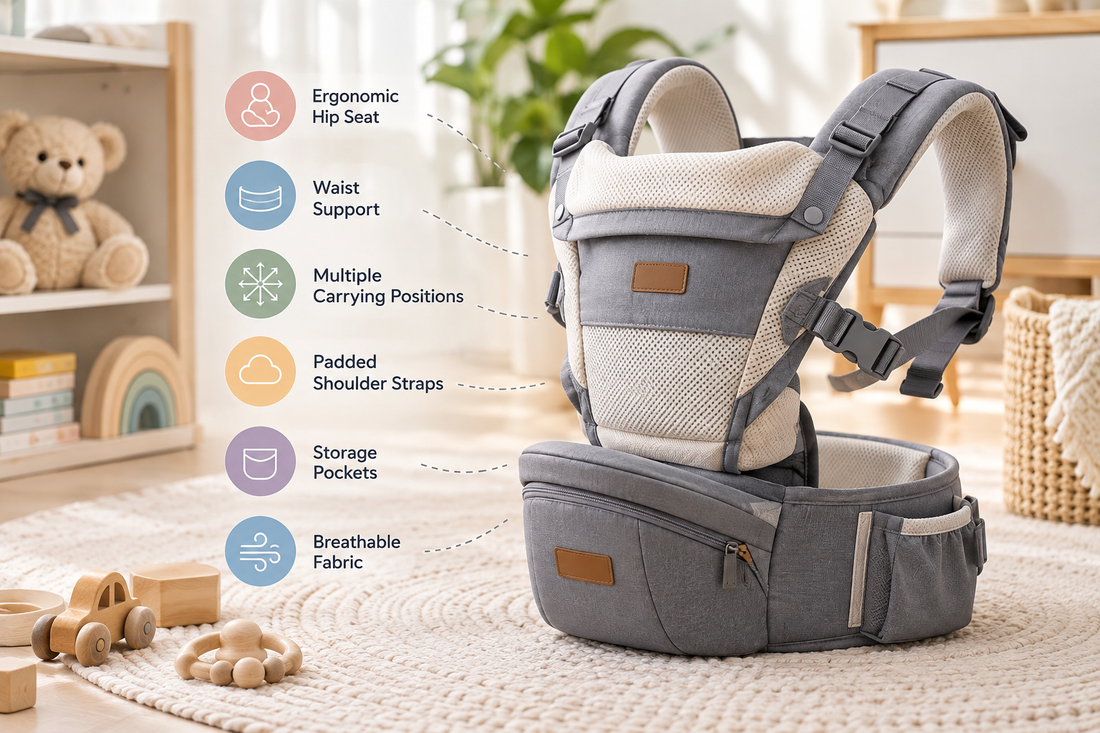
A baby carrier with seat can give parents a more structured way to keep their child close while reducing some of the pressure that comes with repeated carrying. Depending on the design, the seat may be integrated into a full carrier with shoulder straps or built into a supportive waist section.
Parents comparing a baby carrier with hip seat, structured front carrier, or multifunction carrier should consider more than the number of carrying positions. Baby age, weight, seat construction, caregiver fit, waist support, and everyday use all affect whether a carrier feels practical. This guide explains the main designs and how to choose the right option for your family.
What Is a Baby Carrier with Seat

A baby carrier with seat combines a defined sitting area with a carrying system designed to support the child against the caregiver.
Unlike a traditional baby wrap, where the seat is created through fabric tension, a seat-based carrier has a more structured base. Some designs use an integrated hip seat, while others use a shaped carrier panel that creates a supportive sitting position.
Common features may include:
-
Structured or shaped seat
-
Adjustable waist belt
-
Padded shoulder straps
-
Front carrier panel
-
Adjustable buckles
-
Head or back support
-
Storage pockets
-
Multiple carrying configurations
Parents can compare structured and softer options through the Baby Carriers collection at Mommy’s Mart.
Understanding the carrier structure first makes the rest of the comparison much easier.
Baby Carrier with Hip Seat vs Regular Carrier
A baby carrier with hip seat uses a firm or semi-firm platform around the caregiver's waist. The child sits on this platform while the upper section of a full carrier provides additional support.
A regular structured carrier may use a shaped fabric seat without a separate platform.
|
Feature |
Hip Seat Carrier |
Regular Structured Carrier |
|
Sitting area |
Defined hip seat |
Shaped carrier panel |
|
Waist support |
Central to the design |
Usually included |
|
Shoulder straps |
Included on full models |
Usually included |
|
Product size |
Often bulkier |
Often more compact |
|
Storage |
Frequently available |
Model dependent |
|
Quick pick-up use |
Useful on compatible designs |
Depends on setup |
A baby carrier with seat can therefore feel more structured, while a standard carrier may be easier to pack and store.
The right design depends on whether you value a defined seat or a more compact carrying system.
How a Baby Hip Seat Carrier Works
A baby hip seat carrier shifts part of the child's weight toward a wide waist section rather than asking the caregiver's arms or shoulders to manage the full load.
On full carrier models, shoulder straps and an upper panel work together with the seat.
A typical setup may include:
-
Wide adjustable waist belt
-
Structured sitting platform
-
Upper carrier panel
-
Shoulder straps
-
Side buckles
-
Safety fastening points
Some models allow the seat section to be used independently, while others are designed to remain assembled.
A baby carrier with seat should always be used according to its own instructions because seemingly similar models can have different configurations.
Correct setup matters more than the number of features included.
Who May Prefer a Baby Carrier with Seat
Parents may consider a baby carrier with seat when they want more structure than a fabric wrap or regularly pick up and carry a growing child.
It may be useful during:
-
Shopping trips
-
Family visits
-
Short walks
-
Busy public places
-
Travel
-
Frequent pick-up and put-down routines
-
Everyday errands
A defined seat can feel particularly useful as a baby becomes heavier, provided the product remains appropriate for the child's age and weight.
Parents who mainly need a compact newborn solution may prefer a softer option instead.
Your daily routine should determine whether the additional structure is genuinely useful.
Is a Baby Carrier with Seat Suitable for Newborns
Not every baby carrier with seat is designed for newborn use.
Many hip-seat products are intended for babies who have reached a later developmental stage, while some complete structured carriers may be approved earlier.
Before using one with a younger baby, check:
|
What to Check |
Why It Matters |
|
Minimum weight |
Confirms basic suitability |
|
Starting age |
Shows intended stage |
|
Head support |
Important for younger infants |
|
Seat configuration |
May change by stage |
|
Approved position |
Not every position works from birth |
|
Manufacturer guidance |
Defines correct use |
Parents specifically looking for a newborn option can also compare softer designs such as the Bnon wrap within the Mommy’s Mart Baby Carriers range.
A newborn should only use a seat-based carrier when the exact product is approved for that stage.
Infant Carrier with Seat
An infant carrier with seat needs to provide the type of support appropriate for the baby's current development.
Young infants can require more head, neck, and upper-body support than older babies.
Parents should review:
-
Carrier panel height
-
Head support
-
Seat width
-
Waist adjustment
-
Shoulder strap fit
-
Approved inward-facing position
A baby carrier with seat should never be selected simply because the padding looks comfortable.
The manufacturer's age, weight, and positioning instructions remain the most important guide.
What Makes an Ergonomic Baby Carrier

An ergonomic baby carrier should provide practical support for both the child and caregiver.
A large padded seat alone does not make a carrier ergonomic.
For the child, look at:
-
Stable sitting support
-
Appropriate seat width
-
Back support
-
Secure positioning
For the caregiver, check:
-
Waist belt adjustment
-
Shoulder strap position
-
Weight distribution
-
Carrier stability
A well-adjusted baby carrier with seat should remain close to the caregiver rather than pulling away or shifting during normal movement.
Ergonomic support comes from the full fit, not one individual feature.
Front Baby Carrier with Seat
A front baby carrier with seat keeps the child positioned in front of the caregiver while using a structured base or seat.
Depending on the product and child's stage, front configurations may include parent-facing or outward-facing positions.
Before changing position:
-
Check the manufacturer's instructions.
-
Confirm your child's stage.
-
Review head and upper-body control.
-
Adjust the seat.
-
Recheck all buckles.
-
Confirm the child remains supported.
A baby carrier with seat offering several front configurations does not mean every configuration can be used immediately.
Only use positions approved for your baby's current stage.
Baby Waist Seat vs Full Carrier
A baby waist seat is not always the same as a complete carrier.
A seat-only design usually creates a supported platform around the caregiver's waist, but the caregiver may still need to hold the child.
A full baby carrier with seat adds shoulder straps and an upper carrier body.
|
Feature |
Waist Seat Only |
Full Carrier with Seat |
|
Structured seat |
Yes |
Yes |
|
Shoulder straps |
Usually no |
Yes |
|
Upper panel |
No |
Yes |
|
Hands-free use |
Limited |
Depending on approved setup |
|
Product size |
Smaller |
Larger |
|
Best for |
Short carrying periods |
More complete carrying |
Parents should understand this distinction before buying because the two designs can serve different purposes.
Choose the format based on how much support you actually need.
Adjustable Baby Carrier Features
An adjustable baby carrier can remain useful for longer when it can adapt to a growing child or different caregivers.
Useful adjustment points may include:
-
Waist belt
-
Shoulder straps
-
Carrier panel
-
Seat width
-
Side straps
-
Head support
Mommy’s Mart currently has structured options such as Kangaro MAX, which includes adjustable sizing, as well as Chicco Soft and Dream with an adjustable seat and supportive waist design.
When comparing a baby carrier with seat, adjustment is often more useful than simply having more carrying positions.
A carrier that fits properly can be more practical than one with a longer feature list.
Baby Carrier with Seat for Growing Babies
As babies gain weight, carrying comfort can change even when the same carrier remains technically suitable.
A baby carrier with seat may provide extra structure, but parents still need to reassess the fit regularly.
Check:
-
Baby weight
-
Seat width
-
Waist belt position
-
Shoulder tension
-
Carrier panel height
-
Overall balance
Growth can also affect how long the caregiver feels comfortable carrying.
A carrier should adapt to your child rather than stay on the same settings for months.
Toddler Carrier with Seat

A toddler carrier with seat may appeal to families whose child alternates between walking and asking to be carried.
At this stage, the child is heavier, so weight distribution becomes increasingly important.
Before continuing with a baby carrier with seat into the toddler stage, review:
-
Maximum weight
-
Seat dimensions
-
Waist support
-
Shoulder adjustment
-
Product condition
-
Caregiver comfort
A toddler can remain below the manufacturer's maximum weight while still becoming uncomfortable for the caregiver during long periods.
Your own comfort is an important practical limit too.
Baby Carrier with Seat vs Baby Wrap
A baby carrier with seat and a wrap use very different systems to support the child.
|
Feature |
Carrier with Seat |
Baby Wrap |
|
Structure |
High |
Soft and flexible |
|
Sitting area |
Defined |
Created with fabric |
|
Fastening |
Buckles and straps |
Tying |
|
Storage |
Usually bulkier |
Very compact |
|
Waist support |
Common |
No structured belt |
|
Learning style |
Strap adjustment |
Wrapping technique |
Parents who prefer lightweight newborn carrying may like wraps, while those looking for more structure may prefer a seat-based carrier.
You can compare both styles through the Baby Carriers collection.
The best style is the one you can fit and use correctly every time.
Baby Carrier with Seat vs Standard Structured Carrier
Not every structured carrier contains a separate hip-seat platform.
A standard model can still create a shaped, supportive seat using an adjustable carrier panel.
A baby carrier with seat may provide:
-
More defined sitting support
-
Wider waist structure
-
Additional bulk
-
Extra storage on some models
A traditional structured model may offer:
-
Smaller storage size
-
Lighter construction
-
Simpler design
-
Fewer rigid components
Parents can compare products such as Kangaro MAX and Chicco Soft and Dream when deciding how much structure they actually need.
The more structured option is not automatically the better one.
Baby Support Carrier for Longer Walks
A baby support carrier becomes more demanding during longer walks because both baby weight and carrier weight affect the caregiver.
When considering a baby carrier with seat for longer use, focus on:
-
Waist belt comfort
-
Shoulder padding
-
Stable seat
-
Breathability
-
Carrier weight
-
Baby weight
-
Ease of adjustment
Take breaks rather than assuming the carrier should remain comfortable indefinitely.
A supportive design can improve carrying, but it cannot remove the physical load completely.
Baby Carrier with Seat for Travel
Travel is one situation where a baby carrier with seat can be useful, especially in airports, crowded areas, stairs, and destinations where a stroller is inconvenient.
However, structured seat carriers can occupy more luggage space than wraps.
Before travelling, consider:
-
Carrier size when stored
-
Total carrier weight
-
Baby weight
-
Climate
-
Walking duration
-
Whether another adult will use it
Parents can keep nappies, feeding items, and spare clothes in a separate Baby Bag instead of overloading carrier pockets.
A good travel carrier should simplify the journey rather than become another bulky item to manage.
Baby Carrier with Seat vs Stroller
A baby carrier with seat and stroller solve different transport problems.
|
Situation |
Carrier with Seat |
Stroller |
|
Stairs |
Usually convenient |
More difficult |
|
Crowded spaces |
Easy to manoeuvre |
Can be bulky |
|
Long flat routes |
Depends on parent comfort |
Often easier |
|
Child weight |
Carried by adult |
Supported by stroller |
|
Storage |
Limited |
Usually larger |
|
Quick errands |
Useful |
Depends on setup |
Parents can browse Baby Strollers at Mommy’s Mart when comparing carrying with wheeled travel.
Many families benefit from using both depending on the destination.
Multifunction Baby Carrier Features
A multifunction baby carrier may offer several positions, adjustable sections, pockets, removable components, or an integrated seat.
More features can sound attractive, but they only add value when you actually use them.
Ask:
-
Will I use the hip seat separately?
-
Do I need several positions?
-
Will two caregivers share it?
-
Do I need built-in storage?
-
Is compact storage important?
-
Will I travel frequently?
A baby carrier with seat with ten features is not automatically better than a simpler carrier that matches your routine.
Buy according to real use rather than the number of functions advertised.
Comfort in Warm Weather
A structured baby carrier with seat may feel warmer than a thin wrap because it contains more fabric, padding, and support materials.
For warmer weather:
-
Use lightweight baby clothing
-
Avoid unnecessary layers
-
Choose breathable materials when possible
-
Take regular breaks
-
Check your baby frequently
-
Avoid prolonged exposure to extreme heat
The Chicco Soft and Dream currently listed by Mommy’s Mart uses breathable materials and mesh side panels as part of its structured design.
Climate is worth considering when you expect to use the carrier outdoors regularly.
Common Baby Carrier with Seat Mistakes
Choosing a baby carrier with seat becomes easier when parents avoid a few common mistakes.
Assuming Every Seat Works for Newborns
Hip-seat and structured models can have very different starting requirements.
Choosing Padding Instead of Fit
Thick padding cannot correct an unsuitable seat or poor adjustment.
Ignoring the Waist Belt
The waist section is especially important on seat-based designs.
Using an Unapproved Position
Do not change carrying positions simply because the carrier physically allows you to move the baby.
Overloading Storage Pockets
Extra items add to the total weight the caregiver must carry.
Buying for Features You Will Not Use
A complicated multifunction carrier can be unnecessary for simple everyday trips.
Avoiding these mistakes can make a baby carrier with seat purchase much more practical.
How to Choose a Baby Carrier with Seat
Use the same comparison process for every model.
-
Check baby age and weight
Start only with suitable products. -
Choose seat-only or full carrier
Decide how much support you need. -
Review the seat design
Look at stability and intended positioning. -
Check caregiver support
Compare waist and shoulder adjustment. -
Review approved positions
Focus only on configurations you will use. -
Consider storage size
Structured seats can be bulkier. -
Compare maintenance
Check whether fabric components are washable. -
Compare available models
Evaluate products using the same criteria.
The Mommy’s Mart Baby Carriers collection provides several soft and structured designs to compare.
A well-chosen baby carrier with seat should fit your baby, your body, and your everyday routine.
How to Care for a Baby Carrier with Seat

A baby carrier with seat may contain fabric, padding, foam, buckles, and a structured seat insert, so cleaning methods vary.
Always start with the manufacturer's instructions.
General care includes:
-
Clean spills quickly
-
Wipe buckles and hard surfaces
-
Check waist straps
-
Inspect shoulder straps
-
Allow fabric to dry completely
-
Check seams regularly
-
Store in a dry location
Do not machine-wash or soak rigid components unless the instructions specifically allow it.
Regular maintenance also gives you a chance to inspect the carrier for wear.
Why Shop Baby Carriers at Mommy’s Mart
At Mommy’s Mart, parents can compare different babywearing styles alongside other travel essentials.
The Baby Carriers collection includes options such as:
-
Structured carriers
-
Adjustable designs
-
Soft baby wraps
-
Different support styles
Parents can also explore Baby Strollers and Baby Bags for everyday outings.
This makes it easier to compare a baby carrier with seat with other practical travel options before buying.
Frequently Asked Questions
What is a baby carrier with seat?
A baby carrier with seat has a defined sitting area for the baby, usually combined with a waist belt and, on full carriers, shoulder straps and an upper support panel.
Exact construction varies by model.
What is a baby carrier with hip seat?
A baby carrier with hip seat uses a structured platform positioned around the caregiver's waist.
Full models combine the seat with an upper carrier section.
Can a newborn use a baby carrier with seat?
Only when the exact carrier is specifically approved for newborn use.
Check minimum age, weight, head support, seat configuration, and manufacturer instructions.
Is a baby carrier with seat ergonomic?
It can provide supportive features, but ergonomics depends on the complete fit.
Seat shape, child positioning, waist support, shoulder adjustment, and caregiver fit all matter.
Can I use the hip seat without the shoulder straps?
Some designs allow separate seat use, while others do not.
Follow the instructions for your exact carrier.
Is a baby waist seat hands-free?
Usually not by itself.
A waist seat often requires the caregiver to continue supporting the child, while a complete carrier may provide hands-free support when properly secured.
Is a baby carrier with seat good for toddlers?
Some models support older babies and toddlers within specific weight limits.
Always check maximum weight, seat dimensions, and caregiver comfort.
Is a carrier with a seat better than a wrap?
Neither is automatically better.
A seat carrier provides more structure, while a wrap is usually lighter and more compact.
Can I travel with a baby carrier with seat?
Yes, when the model suits your child and travel needs.
Remember that structured seat carriers may be bulkier than simple fabric carriers.
Where can I compare structured baby carriers?
Parents can browse the Baby Carriers collection at Mommy’s Mart to compare structured and soft options.
Review the specifications of each carrier before choosing.
Find the Right Baby Carrier with Seat
A baby carrier with seat can be a practical choice when you want more structure, stronger waist support, or a defined sitting base for a growing child. The right design should match your baby's age and weight while remaining comfortable and adjustable for the caregiver.
Compare seat design, waist support, shoulder straps, approved carrying positions, storage size, and everyday use before buying. Explore the Mommy’s Mart Baby Carriers collection to find a baby carrier with seat or structured alternative that fits naturally into your family routine.