
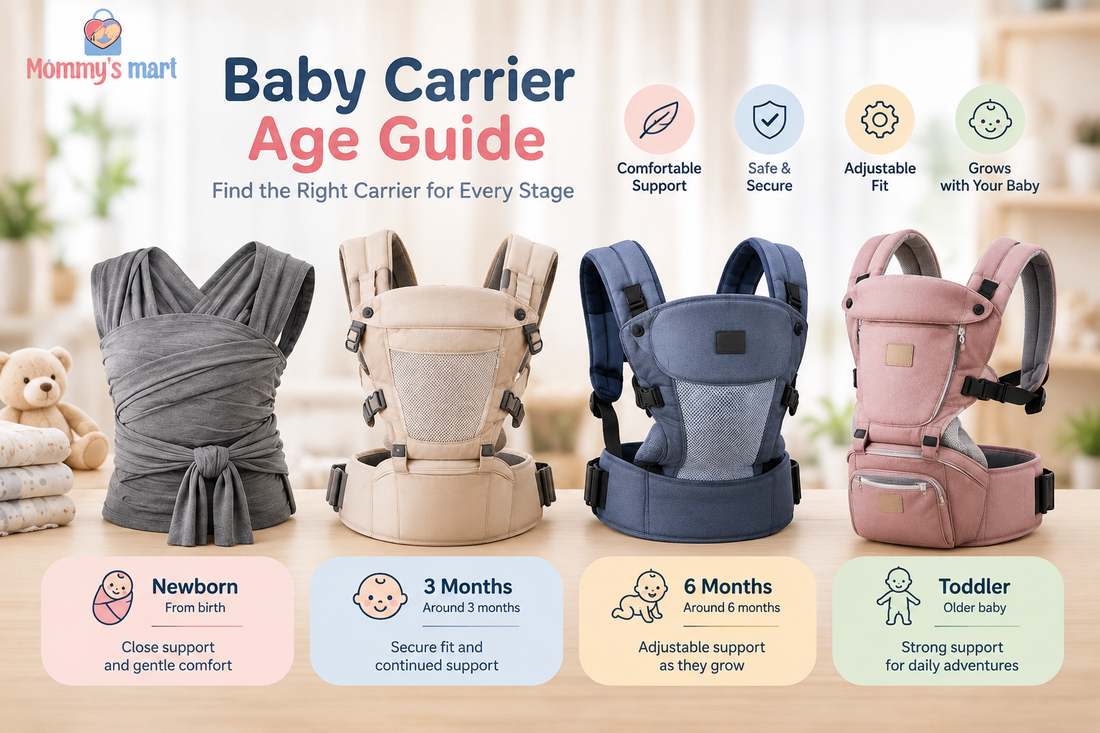
Choosing the correct baby carrier age is one of the first things parents should consider before using a wrap, sling, or structured carrier. A product suitable from birth may need special newborn positioning, while another carrier may be designed for an older or heavier baby.
There is no single baby carrier age that works for every product. Age, weight, head control, body development, approved carrying positions, and the manufacturer’s instructions all matter. This guide explains what to look for from the newborn stage through six months and beyond, helping you choose a carrier that matches your baby’s current needs.
Baby Carrier Age at a Glance

A baby carrier age chart is useful for understanding the main stages, but it should never replace the instructions supplied with your particular carrier.
Two babies of the same age may have different weights and levels of head or body control, so the correct carrier setup can also differ.
|
Baby Stage |
What to Look For |
Main Priority |
|
Newborn |
Carrier specifically approved from birth |
Head, neck and body support |
|
Around 3 months |
Secure inward carrying and correct fit |
Continued head support |
|
Around 6 months |
Adjustable structured support |
Development and positioning |
|
Older baby |
Higher weight capacity |
Weight distribution |
|
Toddler |
Strong adjustable support |
Parent and child comfort |
Parents can explore the Baby Carriers collection at Mommy’s Mart to compare wrap and structured options for different stages.
A useful baby carrier age guide starts with age but always checks weight and development too.
When Can Baby Use a Carrier
The answer to when can baby use carrier products depends on the exact product you buy.
Some wraps and structured carriers are specifically designed for newborn use, while other models have minimum weight or developmental requirements.
Before using a carrier, check:
-
Minimum recommended weight
-
Starting age
-
Maximum weight
-
Head and neck support
-
Approved carrying direction
-
Seat adjustment
-
Manufacturer instructions
For example, the Bnon Baby Wrap Carrier available at Mommy’s Mart is listed as suitable from birth.
Your baby carrier age decision should therefore begin with the product specifications rather than a general age recommendation.
Newborn Baby Carrier Age
The newborn stage requires more attention because a very young baby has limited head and neck control.
When considering baby carrier age from birth, choose only a carrier specifically designed for newborn use. Do not assume that every soft or padded carrier is suitable from the first days.
A newborn carrier should offer:
-
Suitable head and neck support
-
Close body positioning
-
Secure adjustment
-
Clear newborn instructions
-
Appropriate leg and back support
-
Easy visibility of the baby’s face
-
A fit that keeps the baby close to the caregiver
The baby’s face should remain visible and unobstructed while being carried, and parents should regularly check the baby’s position.
The correct newborn baby carrier age setup should prioritise support and easy monitoring rather than multiple carrying positions.
Best Baby Carrier for Newborn Use
The best baby carrier for newborn use does not have to be the biggest or most expensive carrier.
A soft wrap can be practical because it adapts around the caregiver and baby, while some structured products may also be suitable when their manufacturer specifically approves newborn use.
When comparing newborn options, focus on:
|
Feature |
Why It Matters |
|
Approved from birth |
Confirms newborn suitability |
|
Minimum weight |
Baby must meet the product limit |
|
Head support |
Important in early development |
|
Easy adjustment |
Helps keep baby close |
|
Soft contact areas |
Supports everyday comfort |
|
Clear instructions |
Helps parents use it correctly |
The Bnon Baby Wrap Carrier is one option parents can compare when looking for a soft newborn carrier.
At this baby carrier age, simplicity, correct support, and a secure fit matter more than extra features.
Baby Carrier for 3 Month Old Babies

Choosing a baby carrier for 3 month old use still requires careful attention to development.
At around three months, some babies begin showing stronger head control, but parents should not assume that every baby is ready for a new carrying position at exactly the same time.
Check these points:
-
Baby still meets the carrier’s weight range.
-
Head support remains appropriate.
-
The approved carrying direction is being used.
-
The carrier still fits the baby’s body correctly.
-
Straps have been adjusted as the baby has grown.
-
The baby remains easy to monitor.
This baby carrier age is often a transition stage rather than a reason to immediately buy a different product.
A secure and correctly adjusted inward-facing setup may still be the most practical choice.
Baby Carrier for 6 Month Old Babies
A baby carrier for 6 month old use may offer more options because many babies have greater head and upper-body control by this stage.
However, six months should not automatically mean outward-facing or back carrying.
At this baby carrier age, parents should reassess:
-
Baby weight
-
Seat width
-
Head and back support
-
Shoulder adjustment
-
Waist support
-
Approved carrying positions
-
Comfort during longer use
Parents looking for a structured option can compare the Chicco Soft and Dream Baby Carrier, which Mommy’s Mart lists with an adjustable seat, padded shoulder straps, waist support, and breathable materials.
Six months is a useful point to review the fit, not a fixed deadline for changing carriers.
Baby Carrier by Age and Development
A baby carrier age guide becomes more accurate when age is combined with the baby’s development.
A birthday alone does not determine readiness for a different position.
|
Stage |
Main Carrier Consideration |
|
Birth |
Use only newborn-approved products |
|
Early infancy |
Prioritise close support |
|
Improving head control |
Reassess head and upper-body support |
|
Sitting stage |
Check whether new positions are approved |
|
Older infant |
Focus on weight distribution |
|
Toddler |
Review maximum weight and seat size |
Parents should always follow the manufacturer’s instructions for the exact carrier they own.
Thinking about baby carrier age together with development helps prevent changing positions too early.
Infant Carrier Age vs Baby Weight
Parents often concentrate on infant carrier age, but weight is just as important.
Two six-month-old babies can have very different weights, which means one carrier may fit one child differently from another.
Always check:
-
Minimum age
-
Minimum weight
-
Maximum weight
-
Developmental requirements
-
Carrier dimensions
-
Approved positions
The Kangaro MAX Carrier currently lists a supported range of 4–25 kg and adjustable height and width.
That makes weight an important part of any baby carrier age comparison.
Age provides a general stage, while weight helps confirm whether the child remains inside the product’s limits.
Understanding the Baby Carrier Age Limit
The baby carrier age limit is not always printed as one simple number.
Some products use weight as their main limit, while others combine age, weight, size, and developmental milestones.
You may need to stop using or reassess a carrier when:
-
Baby reaches the maximum weight.
-
The child no longer fits the seat correctly.
-
The carrier panel becomes too small.
-
Straps no longer adjust correctly.
-
The manufacturer specifies a developmental limit.
-
The carrier becomes damaged.
A baby carrier age limit should therefore be viewed as part of the complete fit rather than a birthday when the carrier suddenly becomes unsuitable.
The carrier should remain comfortable and correctly adjusted throughout its entire period of use.
How Carrier Fit Changes With Age
Your first carrier setup should never remain unchanged for months.
As baby carrier age increases, the baby grows in height and weight, which can change how the carrier needs to be adjusted.
Growth may affect:
-
Seat width
-
Carrier panel height
-
Shoulder tension
-
Waist belt position
-
Head support
-
Leg positioning
-
Carrying direction
Newborn Stage
More complete body and head support is usually required.
Three-Month Stage
Regular adjustment becomes important as the baby grows quickly.
Six-Month Stage
Parents may need to review seat width and approved carrying positions.
Older Baby Stage
Weight distribution becomes increasingly important for the caregiver.
Checking the fit regularly helps the carrier adapt as your baby develops.
Safe Baby Carrier Age
A safe baby carrier age cannot be defined by age alone.
Safe babywearing depends on using an appropriate carrier, following the product instructions, and keeping the baby correctly positioned.
At every baby carrier age, parents should check:
-
Baby is within the approved weight range.
-
The carrying position is allowed.
-
The baby’s face is visible.
-
The nose and mouth remain unobstructed.
-
Straps and fasteners are secure.
-
The carrier is not damaged.
-
Baby remains properly supported.
Younger babies require particularly careful monitoring because they have less head and neck control.
The safest approach is to match the baby’s stage with the exact instructions supplied with the carrier.
Baby Wearing Age and Carrying Positions

Baby wearing age affects which carrying positions may be available.
A carrier advertised with several positions does not mean every position can be used from birth.
|
Carrying Position |
What to Check |
|
Inward-facing front |
Newborn approval and support |
|
Outward-facing front |
Head and upper-body readiness |
|
Hip carrying |
Manufacturer guidance |
|
Back carrying |
Developmental requirements |
|
Wrap position |
Correct tying instructions |
Parents should never change positions simply because another baby of the same age uses that position.
At each baby carrier age, use only the positions specifically approved for your child and carrier.
That makes gradual changes much safer and easier to manage.
When to Adjust Your Baby Carrier
A growing baby does not always need a new carrier.
Sometimes the correct solution is simply to adjust your existing product.
Recheck the fit when:
-
Baby begins sitting lower.
-
Shoulder straps feel different.
-
The seat looks too narrow.
-
Leg positioning changes.
-
Head support sits too high or low.
-
The carrier starts pulling away from your body.
-
Baby has gained noticeable weight.
The adjustable Kangaro MAX Carrier can be useful to compare if you want a structured model designed to change in height and width.
Regular adjustment helps your carrier continue matching the current baby carrier age.
When to Change to Another Baby Carrier
There is no rule saying parents need to buy a new carrier every few months.
A change becomes useful when the current carrier no longer suits your child or your routine.
Consider changing when:
-
Baby reaches the product limit.
-
You want a different approved carrying position.
-
Parent comfort becomes poor.
-
Baby has outgrown the carrier panel.
-
You need stronger weight distribution.
-
Your travel routine has changed.
-
The existing carrier is damaged.
Parents can compare structured and soft options in the Baby Carriers collection before deciding whether an upgrade is necessary.
Changing carriers should solve a real problem rather than simply respond to baby carrier age alone.
Baby Carrier Age for Travel
Travel needs change significantly as babies become heavier.
During the newborn stage, a compact carrier can make short movement through airports, hotels, or family visits easier when it is approved for early use.
At a later baby carrier age, parents may value:
-
Stronger shoulder support
-
Waist support
-
Easier adjustment
-
More structured seating
-
Longer carrying comfort
For older babies, combining a carrier with a stroller can reduce the amount of time the caregiver has to carry the child.
Parents planning trips can compare Baby Strollers and Baby Bags alongside their carrier.
A good travel setup should change as your baby becomes larger and more active.
Baby Carrier vs Stroller by Age
A carrier can be useful throughout several stages, but it does not have to replace a stroller.
|
Baby Stage |
Carrier Advantage |
Stroller Advantage |
|
Newborn |
Close carrying when approved |
Useful for longer outings |
|
Young infant |
Hands-free movement |
Reduces weight on caregiver |
|
Older baby |
Easy in narrow spaces |
More practical for long trips |
|
Toddler |
Useful for shorter carrying |
Better as child becomes heavier |
At an older baby carrier age, the adult may become tired more quickly because the total carried weight increases.
Mommy’s Mart offers both Baby Carriers and Baby Strollers, allowing families to use each option where it makes the most sense.
The two products can complement each other as your child grows.
Common Baby Carrier Age Mistakes
Parents often make carrier decisions based on one number rather than the complete product requirements.
Common mistakes include:
Choosing Only by Age
Baby weight and development also matter.
Assuming Every Carrier Starts From Birth
Only use a carrier from birth when the manufacturer specifically allows it.
Changing Carrying Position Too Early
Do not switch to outward or back carrying based only on age.
Forgetting to Adjust the Carrier
Your baby can change significantly in only a few weeks.
Ignoring Maximum Weight
A carrier may become unsuitable even when the baby carrier age seems acceptable.
Following Another Parent’s Setup
Another baby may use a completely different carrier with different limits.
Avoiding these mistakes makes carrier selection much more reliable.
How to Choose a Baby Carrier by Age

A clear process can make carrier shopping easier.
-
Check age and weight
Start with products that meet both requirements. -
Confirm newborn suitability when needed
Do not assume all carriers work from birth. -
Review baby development
Consider head and upper-body control. -
Check approved positions
Use only the configurations allowed at the current stage. -
Review parent support
Heavier babies increase the importance of weight distribution. -
Look for useful adjustment
An adjustable carrier may stay practical for longer. -
Recheck the fit regularly
Your baby’s needs change over time.
Following this baby carrier age process makes it easier to compare products based on real suitability rather than appearance.
The Mommy’s Mart Baby Carriers collection provides several wrap and structured options to compare.
Baby Carrier Options for Different Ages
Parents may prefer different carrier styles as their child grows.
Bnon Baby Wrap Carrier
The Bnon Baby Wrap Carrier is listed by Mommy’s Mart as suitable from birth, making it relevant for parents comparing an early baby carrier age option.
Chicco Soft and Dream
The Chicco Soft and Dream Baby Carrier offers a structured design with an adjustable seat, padded shoulder straps, waist support, and breathable areas.
Kangaro MAX
The Kangaro MAX Carrier is currently listed for 4–25 kg and includes adjustable height and width.
Comparing these designs shows why no single carrier is automatically ideal for every stage.
Why Shop Baby Carriers at Mommy’s Mart
At Mommy’s Mart, parents can compare carriers designed for different stages, weights, and everyday routines.
The Baby Carriers collection includes:
-
Newborn wrap options
-
Structured carriers
-
Adjustable designs
-
Different weight ranges
Parents can also browse Baby Strollers and Baby Bags as their travel needs change.
This makes it easier to match your baby carrier age with the type of baby gear that fits your current routine.
Frequently Asked Questions
What is the best baby carrier age to start?
There is no universal starting age. The correct baby carrier age depends on whether the exact carrier supports your baby’s age, weight, size, and developmental stage.
Always check the manufacturer’s instructions before the first use.
Can a newborn use a baby carrier?
Yes, when the carrier is specifically designed and approved for newborn use.
Check minimum weight, head support, fit, and the approved newborn position.
Can I use a baby carrier for a 3 month old?
Yes, provided your child remains within the product requirements.
At three months, continue paying close attention to head control and carrier support.
Can I use a baby carrier for a 6 month old?
Many carriers can be used at six months, but approved positions vary by product.
Do not assume six months automatically means outward-facing or back carrying.
What is the baby carrier age limit?
The limit varies between products.
Some carriers mainly use weight limits, while others include age, size, developmental milestones, or position-specific guidance.
Is weight more important than baby carrier age?
Both matter.
Age indicates a general developmental stage, while weight confirms whether the baby remains inside the carrier’s physical limits.
When can my baby face outward?
Only use outward-facing carrying when your carrier manufacturer approves it and your baby meets the required developmental stage.
Do not rely on age alone.
When can I carry my baby on my back?
Back carrying depends on the carrier and the baby’s development.
Use it only when the product specifically supports that position and all requirements are met.
Do I need a new carrier as my baby grows?
Not always.
Many carriers can be adjusted as a baby grows, but replacing the carrier may be useful when your child reaches its limits or your carrying needs change.
Which carrier can I consider for a newborn?
Choose a product specifically listed for newborn use.
The Bnon Baby Wrap Carrier at Mommy’s Mart is currently listed as suitable from birth.
Always follow the specific product instructions before use.
Find the Right Baby Carrier for Every Age
The correct baby carrier age depends on your baby’s age, weight, development, and the exact carrier design. A newborn may need a soft carrier specifically approved from birth, while an older baby may benefit from more structured support and stronger weight distribution.
Review the fit regularly as your child grows and move to new carrying positions only when the product allows them. Explore the Baby Carriers collection at Mommy’s Mart to compare products and find the right option for your current baby carrier age and everyday routine.