
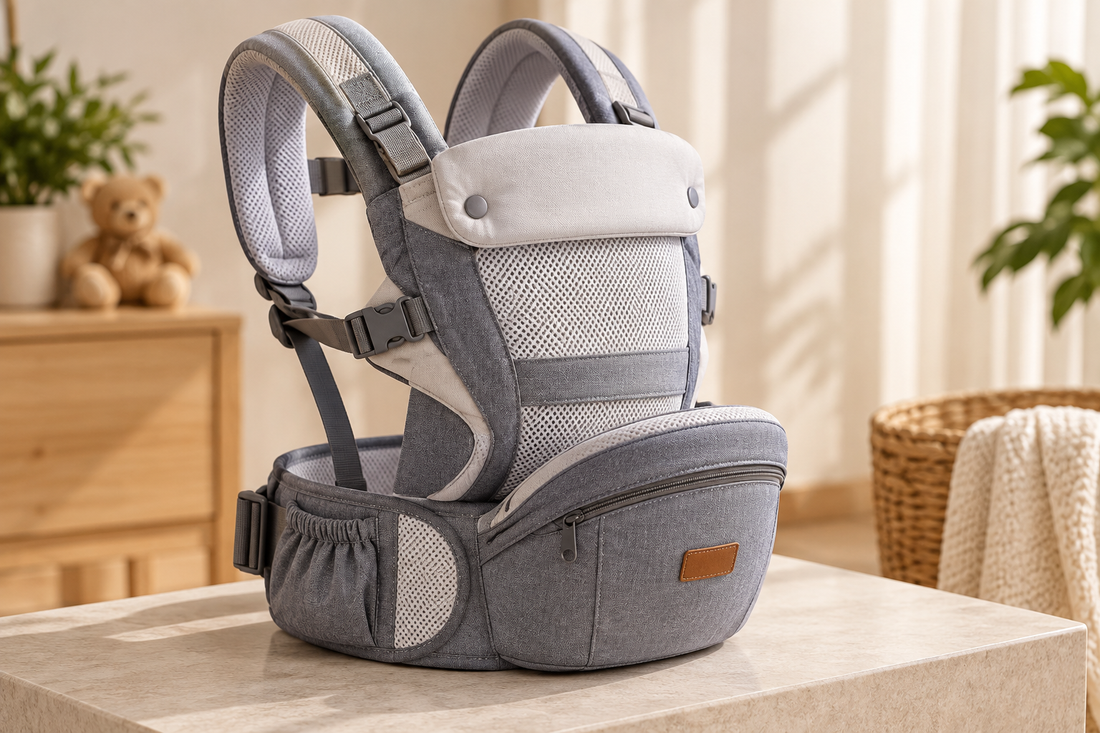
A baby hip carrier can be useful when your baby is getting heavier, wants to be picked up frequently, or no longer stays happily in one carrying position for long. Instead of relying entirely on your arms, a hip-style carrier can create a supported place for the child while transferring part of the load toward your waist.
But hip carriers come in very different forms. Some are simple seat-only products, while others combine a hip seat with shoulder straps and a full carrier panel. Understanding that difference is more important than choosing the product with the most features.
This guide looks at when hip carrying makes sense, how to judge waist support, what to check as your child grows, and how a baby hip carrier compares with wraps, structured carriers, and strollers.
Does a Baby Hip Carrier Fit Your Routine

Before comparing products, think about why you want a baby hip carrier in the first place.
Hip carrying is particularly attractive when a child frequently switches between walking, sitting, exploring, and asking to be carried again. Instead of repeatedly holding the child directly on your hip, the carrier provides a more defined support point.
It can suit routines such as:
-
Short shopping trips
-
Family visits
-
Quick walks
-
Carrying around public spaces
-
Frequent pick-up and put-down
-
Travel with an older baby
-
Short periods with a toddler
Parents who mainly want a newborn carrier may have different priorities and can compare softer options in the Baby Carriers collection.
The best hip carrier is the one solving a real daily carrying problem.
Hip Seat Carrier or Full Carrier
One of the most important distinctions is between a simple hip seat carrier and a complete carrier built around a hip seat.
A seat-only design normally wraps around the adult's waist and provides a platform for the child. The caregiver may still need to keep an arm around the baby.
A full baby hip carrier usually adds an upper carrier panel and shoulder straps.
|
Feature |
Seat-Only Hip Carrier |
Full Hip Carrier |
|
Waist seat |
Yes |
Yes |
|
Shoulder straps |
Usually no |
Yes |
|
Upper baby support |
Limited |
More complete |
|
Hands-free potential |
Limited |
Greater when correctly secured |
|
Setup |
Usually faster |
More adjustment |
|
Size |
Smaller |
Bulkier |
|
Best use |
Quick pick-up periods |
Longer supported carrying |
Parents should decide which style they actually need before comparing colours or accessories.
Choosing the correct carrier format can eliminate many unsuitable products immediately.
Why a Baby Hip Seat Can Feel Different
A baby hip seat changes where some of the child's weight is supported.
When you hold a child naturally on one hip, your arm, shoulder, and side often compensate for the load. A structured seat moves some of that support to a waist-mounted platform.
That can be useful when:
-
Your baby asks to be carried frequently.
-
You carry for several short periods each day.
-
The child is becoming heavier.
-
You want a defined sitting base.
-
You frequently alternate between carrying and putting the child down.
This does not mean a hip seat eliminates physical effort. The caregiver still carries the total weight of the child and carrier.
A baby hip carrier should improve how the load feels, not create unrealistic expectations about weight disappearing.
The Waist-Belt Test Before You Buy
The waist section is one of the most important parts of a baby hip carrier, yet parents often pay more attention to the shoulder straps.
Before buying, imagine how the belt will behave during a 20-minute walk rather than during a quick fitting.
Check whether the waist section:
-
Has enough adjustment for your body
-
Feels stable rather than slippery
-
Sits where the manufacturer intends
-
Does not fold excessively under load
-
Can be tightened securely
-
Uses reliable fastening points
A waist baby carrier that constantly slides downward can quickly become frustrating even if the seat itself feels comfortable.
Strong waist adjustment is one of the main reasons to compare fit carefully.
Baby Hip Carrier vs Carrying on Your Natural Hip
Parents often hold an older baby directly against one hip because it feels quick and natural.
The problem is that repeated one-sided carrying can become tiring.
A baby hip carrier can create a more consistent support point and, on complete models, use straps or a carrier panel to reduce how much the caregiver has to hold with one arm.
|
Carrying by Hand |
Using a Hip Carrier |
|
Very quick |
Requires setup |
|
No extra equipment |
Adds carrier weight |
|
Load is often one-sided |
Can provide a defined seat |
|
Arm remains occupied |
Full models may free both hands |
|
Fine for very short periods |
More practical for repeated carrying |
A carrier makes the most sense when carrying becomes frequent enough that extra support is worth the setup.
For a 30-second pick-up, your arms may still be simpler.
Can an Infant Use a Hip Carrier
An infant hip carrier should only be used when the exact product is designed for the baby's age, weight, and development.
Seat-style carriers can look supportive but may be intended for babies who are further along developmentally.
Before using a baby hip carrier with a younger infant, review:
-
Minimum weight
-
Starting age
-
Head-control requirements
-
Seat-only instructions
-
Full-carrier instructions
-
Approved carrying positions
Parents looking specifically for an early newborn solution may want to compare the Bnon Baby Wrap Carrier, which Mommy’s Mart currently lists as suitable from birth.
A hip seat should never be treated as newborn-ready simply because it has padding.
When a Toddler Hip Carrier Makes More Sense

A toddler hip carrier can become more appealing once a child starts walking independently but still asks to be carried regularly.
This creates a very different use case from newborn babywearing.
A toddler may:
-
Walk for five minutes
-
Ask to be carried
-
Want to get down again
-
Become tired later
-
Need another short carry
A complicated carrier may feel excessive for that routine, while a supportive seat can make repeated pick-up easier.
At this stage, however, maximum weight and caregiver comfort become especially important.
A baby hip carrier should remain manageable for the adult even when the child technically stays within the stated product limit.
What Makes an Ergonomic Hip Carrier
An ergonomic hip carrier is not simply a product with a thick cushion.
The complete fit matters.
For the child, compare:
-
Seat stability
-
Back support on full carriers
-
Leg position
-
Carrier panel fit
-
Approved age and weight
For the caregiver, compare:
-
Waist-belt width
-
Shoulder strap adjustment
-
Balance
-
Carrier height
-
Pressure around the hips
A carrier that is highly padded but constantly tilts to one side may be less practical than a simpler design that fits correctly.
A well-fitted baby hip carrier should feel stable before it feels luxurious.
Adjustable Hip Seat for Shared Use
An adjustable hip seat becomes more valuable when two caregivers have different body sizes.
Instead of buying based only on whether the belt technically fits, check how much useful adjustment is available.
A good shared carrier should allow each caregiver to reset:
-
Waist circumference
-
Shoulder strap length
-
Carrier panel tension
-
Seat position where applicable
-
Side adjustment
Parents comparing adjustable structured alternatives can also look at the Kangaro MAX Carrier, which Mommy’s Mart currently lists with adjustable height and width and a 4–25 kg stated range.
Shared carriers work best when each person adjusts the setup rather than inheriting the previous fit.
Hip Seat or Structured Carrier for Longer Walks
A baby hip carrier can feel convenient during repeated short carrying, but a traditional structured carrier may suit some longer walks better.
The decision depends on how the load is distributed.
Consider this simple comparison:
|
Your Routine |
More Important Feature |
|
Frequent pick-up and put-down |
Easy hip-seat access |
|
Continuous longer carrying |
Shoulder and waist distribution |
|
Shopping |
Quick adjustment |
|
Travel |
Compact storage |
|
Older baby |
Strong waist support |
|
Warm weather |
Breathability |
The Chicco Soft and Dream Baby Carrier provides one structured comparison point, with Mommy’s Mart currently listing an adjustable seat, padded shoulder straps, waist support, and breathable materials.
Choose support according to how long you actually carry, not just how the product looks.
Baby Carrier with Hip Seat for Hands-Free Use
A baby carrier with hip seat may combine the speed of a seat with the additional support of an upper carrier.
This can be useful when you need both hands available.
A complete baby hip carrier may include:
-
Structured seat
-
Upper carrier panel
-
Shoulder straps
-
Waist belt
-
Head support
-
Storage pocket
-
Multiple adjustment points
The important distinction is that a basic seat by itself may still require you to support the child with an arm.
Always confirm whether the exact product is intended as a full hands-free carrier or only as a support seat.
That difference changes how useful it will be during real everyday tasks.
The Three-Minute Comfort Test
A carrier can feel fine for 20 seconds and uncomfortable after several minutes.
Before committing to a baby hip carrier, test more than the initial fit whenever possible.
Minute one
Check whether the waist belt stays level.
Minute two
Walk naturally and notice whether the carrier shifts sideways.
Minute three
Check your lower back, waist, and shoulders for obvious pressure.
Then reassess the child’s seat and position.
If the carrier already needs constant correction during a short test, it is unlikely to become easier during a longer walk.
A quick comfort test can reveal more than a long list of specifications.
Baby Waist Carrier for Quick Errands
A baby waist carrier can make particular sense for errands where the child moves frequently between being carried and being active.
For example, during a short shopping trip you may:
-
Carry your child from the car.
-
Put them down briefly.
-
Pick them up in a crowded area.
-
Put them in a trolley.
-
Carry them again when leaving.
A baby hip carrier can fit this stop-start routine better than a carrier that takes several minutes to put on each time.
Parents who mostly carry continuously may prioritise something different.
The frequency of transitions matters just as much as total carrying time.
Is a Hip Carrier Good for Travel
A baby hip carrier can be useful while travelling, particularly with an older baby who wants to switch between walking, being carried, and sitting.
Potential advantages include:
-
Quick access
-
Easier movement on stairs
-
Less dependence on a stroller
-
Useful support during airport queues
-
Practical short-distance carrying
However, hip-seat models can be bulkier than soft wraps.
Parents should consider luggage space and may prefer to keep nappies, feeding items, and spare clothing in a separate Baby Bag.
The best travel carrier is one that simplifies movement without becoming another oversized item to pack.
Baby Hip Carrier or Stroller for a Day Out

A baby hip carrier works best for some parts of a family day, while a stroller can be better for others.
|
Situation |
Hip Carrier |
Stroller |
|
Stairs |
Convenient |
Difficult |
|
Quick stops |
Useful |
Setup may be unnecessary |
|
Long flat walking |
Can become tiring |
Usually easier |
|
Storage |
Limited |
Greater |
|
Child wants to walk |
Easy transition |
Child must enter and exit |
|
Crowded spaces |
Compact around caregiver |
Can be harder to manoeuvre |
Parents can compare Baby Strollers when preparing for longer trips.
Many families get more value from combining the two options instead of expecting one product to handle every outing.
Warm Weather Changes the Decision
A baby hip carrier can sometimes feel less enclosed than a full chest carrier when used as a simple seat, but full hip-seat carriers can still contain substantial padding and fabric.
For warm conditions:
-
Dress baby lightly
-
Choose breathable materials
-
Avoid unnecessary layers
-
Check skin temperature
-
Take carrying breaks
-
Keep the waist area comfortable
Heat can build around wide waist belts, especially during longer walks.
A carrier that feels comfortable indoors may behave differently during a hot outdoor trip.
Do You Really Need Storage on the Carrier
Many hip carriers include pockets, but storage should not become the main buying feature.
Anything placed in a baby hip carrier adds weight around the caregiver’s waist.
Small pockets can be useful for:
-
Keys
-
Phone
-
Small cloth
-
Pacifier
-
One or two light essentials
They are less suitable for turning the carrier into a full diaper bag.
For larger items, the Baby Bags collection gives parents a separate storage option.
Good carrier storage should be convenient, not an invitation to overload the waist belt.
Signs a Hip Carrier Is Not Working for You
A baby hip carrier may not suit every parent.
Reconsider the fit if:
-
The seat repeatedly tilts
-
The waist belt slides down
-
One hip feels overloaded
-
The child constantly moves away from the intended position
-
You need one hand to correct the carrier continuously
-
The product feels disproportionately heavy
-
Your lower back becomes uncomfortable quickly
Some issues can be solved through adjustment, while others suggest a different carrier style may fit better.
Comfort problems should be investigated rather than simply tolerated.
Hip Carrier vs Baby Wrap
A wrap and a baby hip carrier sit at almost opposite ends of the carrier spectrum.
|
Feature |
Hip Carrier |
Baby Wrap |
|
Structure |
High |
Minimal |
|
Seat |
Defined |
Created by fabric |
|
Storage |
Bulkier |
Very compact |
|
Adjustment |
Belt and straps |
Fabric tension |
|
Quick pick-up |
Often useful |
Usually requires setup |
|
Newborn options |
Model dependent |
Available on specific wraps |
A soft wrap can make sense during newborn stages, while a hip carrier may become more interesting as the child grows and routines become more active.
The Baby Carriers collection allows parents to compare both structured and soft approaches. Mommy’s Mart currently lists eight products in the category.
Different stages can justify completely different carrier styles.
When a Standard Carrier May Be Better
Not everyone searching for a baby hip carrier actually needs a hip seat.
A standard structured carrier may be the better choice when:
-
You carry continuously rather than in short bursts
-
Compact storage matters
-
You prefer less rigid equipment
-
Shoulder support is a major priority
-
You do not need a separate seat-only mode
Mommy’s Mart currently lists structured alternatives including Kangaro MAX and Chicco Soft and Dream alongside softer products in its carrier range.
Choosing the simpler product can sometimes create the better everyday experience.
A Smarter Shopping Checklist
Before buying a baby hip carrier, answer these questions in order.
-
How old and heavy is my child?
Remove products outside the approved range. -
Do I need seat-only or full-carrier use?
This determines the basic design. -
How often will I pick the child up and down?
Frequent transitions make quick setup more valuable. -
How long will I carry continuously?
Longer carrying increases the importance of complete support. -
Will another caregiver use it?
Wider adjustment becomes important. -
Will I travel with it?
Consider product size and weight. -
Do I really need storage pockets?
Avoid paying for unnecessary bulk.
This process keeps the decision focused on your routine instead of advertising features.
How to Care for a Hip Seat Carrier

A baby hip carrier may contain fabric, foam, straps, buckles, and a rigid or semi-rigid seat insert.
That means washing instructions can be different from those for a simple wrap.
General care includes:
-
Clean small spills promptly
-
Follow the product washing label
-
Wipe hard seat components where recommended
-
Inspect waist-belt fastening
-
Check buckles regularly
-
Allow fabric to dry fully
-
Store the carrier somewhere dry
Avoid machine-washing a rigid seat insert unless the manufacturer clearly permits it.
Cleaning is also a useful time to inspect the carrier for wear.
Why Compare Carriers at Mommy’s Mart
At Mommy’s Mart, parents can compare structured and soft babywearing options without assuming that one carrier style works for every stage.
The current Baby Carriers collection includes options from Bnon, Chicco, Kangaro, and Petit Bebe.
You can compare:
-
Soft newborn wraps
-
Structured carriers
-
Adjustable designs
-
Different weight ranges
Parents can also explore Baby Strollers and Baby Bags for longer outings.
This makes it easier to decide whether a baby hip carrier, structured carrier, wrap, or stroller fits your routine best.
Frequently Asked Questions
What is a baby hip carrier?
A baby hip carrier supports a child around the caregiver’s waist or hip area, often using a structured seat.
Some models are seat-only products, while others include shoulder straps and a full carrier panel.
Is a hip seat carrier hands-free?
A basic hip seat may still require the caregiver to support the child with an arm.
Full carrier models may provide hands-free carrying when they are designed, fitted, and secured for that purpose.
Can a newborn use a baby hip carrier?
Only when the exact product is specifically approved for newborn use.
Many seat-style products have age, weight, or developmental requirements that make them more appropriate later.
What age is best for a hip seat carrier?
There is no universal age.
Check the specific product’s minimum weight, developmental requirements, carrying positions, and instructions.
Is a baby hip seat good for toddlers?
A hip seat can be useful for toddlers who frequently alternate between walking and being carried.
Always check maximum weight and caregiver comfort.
Is a waist baby carrier better than a normal carrier?
Neither is automatically better.
A waist or hip seat can suit repeated short carrying, while a structured carrier may feel better during continuous longer wear.
How should a hip carrier fit?
The waist section should remain secure and stable, and the child should sit according to the manufacturer’s intended position.
The carrier should not constantly slide, twist, or tilt.
Is a baby hip carrier useful for travel?
It can be useful for airports, queues, stairs, and short-distance carrying.
Consider its packed size because structured hip seats can be bulkier than wraps.
Can two parents share the same hip carrier?
Yes, when the carrier’s adjustment range fits both caregivers.
Each person should reset the waist and shoulder adjustments before carrying.
Where can I compare baby carriers?
Parents can browse the Baby Carriers collection at Mommy’s Mart to compare soft wraps and structured carrier options.
Check the exact age, weight, fit, and carrying instructions before choosing.
Make Hip Carrying Work for Your Family
A baby hip carrier makes the most sense when your child is frequently moving between being active and wanting to be carried. Instead of choosing based on the biggest seat or the most pockets, focus on waist fit, child stage, carrying duration, adjustment, and whether you need a simple seat or a complete carrier.
Explore Baby Carriers at Mommy’s Mart and compare structured options such as Kangaro MAX and Chicco Soft and Dream with softer designs before deciding which carrying system works best for your family.